





What companies really need to know about the transparency obligation under the AI Act
Do all texts created with ChatGPT need a notice? Do marketing posts, blog articles or social media posts generally have to be labeled as AI-generated? This causes uncertainty in many companies.
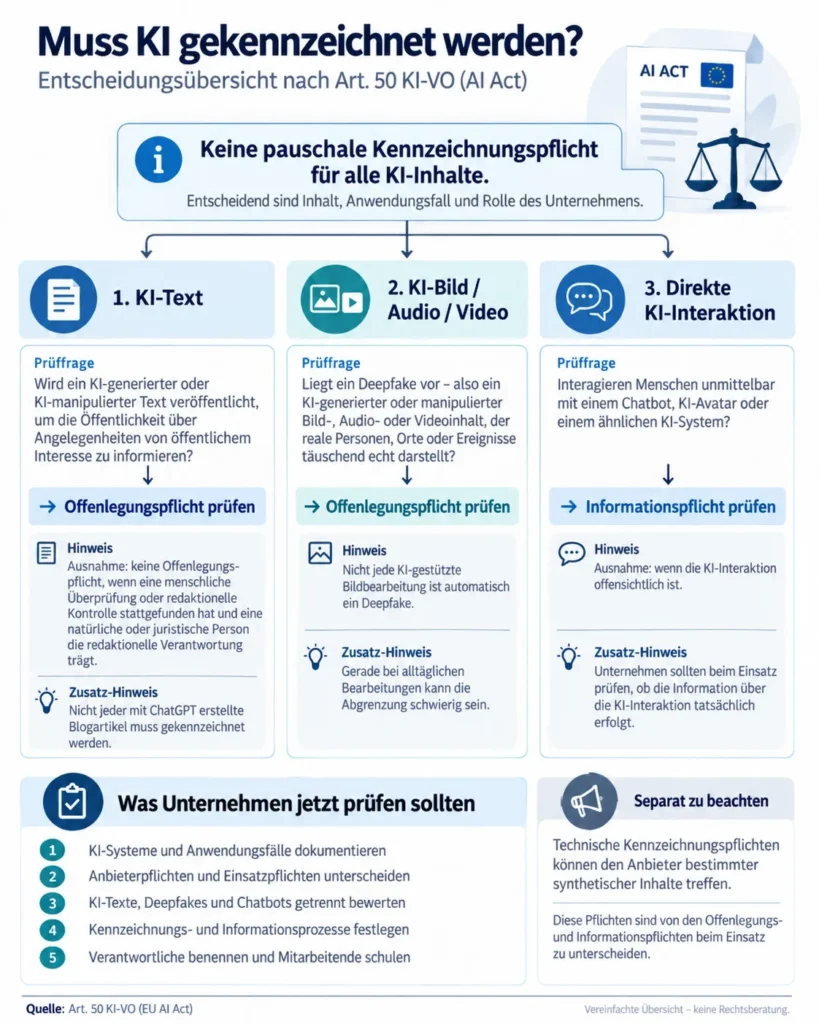
The short answer is: No. The AI Act does not introduce a general labeling obligation for all AI-generated content. Rather, transparency obligations only apply to certain use cases under Article 50 of the AI Regulation.
What are the transparency obligations about?
The aim of the rules is to protect people from deception. That is why the AI Act requires transparency in certain situations that content has been generated or modified by artificial intelligence, or that users are interacting with an AI system. This applies in particular to applications where there is an increased risk that people will not recognize the artificial origin of content or an interaction.
So-called deepfakes are particularly relevant here. The AI Act defines them as AI-generated or AI-manipulated image, audio or video content that deceptively resembles real persons, objects, places or events and can therefore give the impression of being authentic.
In practice, however, the distinction is not always clear. Modern AI systems are used today not only to create entirely new content, but also to support everyday editing functions – for example, removing distracting objects, sharpening images or replacing individual image elements. This raises the question of when permissible AI-assisted editing turns into a deepfake requiring labeling.
Not every AI-generated text has to be labeled
In public discussion, the impression often arises that every text created with ChatGPT or another AI system must be labeled accordingly.
However, it is not that simple. Anyone who creates a blog post or a specialist article with the help of AI and then carefully checks and revises it and takes responsibility for its content is not automatically subject to a labeling obligation. What matters is always the specific use case and the relevant transparency requirements of the AI Act.
For images and videos, it depends on the specific use
Modern smartphones and image editing programs use AI to optimize photos, change backgrounds or remove distracting objects. This does not automatically mean that every edited image must be disclosed as a deepfake.
What matters is whether image, audio or video content is artificially generated or manipulated in such a way that it can appear authentic. Questions of distinction can arise especially with mixed forms of ordinary image editing and generative modification.
For chatbots, AI avatars and other direct AI interactions, the respective transparency obligations must also be checked separately.
What companies should now consider
Not every use of generative AI needs to be adjusted. However, companies should record which systems they use, where content is generated or modified automatically and which obligations under Article 50 apply to the respective role and use.
Additional guidance is provided by the European Commission guidelines on Article 50 of the AI Regulation published in July 2026 and the voluntary code of practice on the transparency of AI-generated content. The code specifies practical measures for technical labeling and disclosure. Its application is voluntary; the statutory transparency obligations remain binding regardless.
Transparency is only one building block of AI compliance
The labeling obligations are only part of the requirements of the AI Act. Equally important are, for example, employees’ AI literacy, clear internal rules on the use of generative AI and functioning AI governance.
Companies should therefore not reduce the AI Act to the question of whether a notice is required under an AI-generated image or text. Rather, it is about designing the use of artificial intelligence as a whole in a responsible and legally compliant way.
Conclusion
The AI Act does not require blanket labeling of all AI-generated content. What matters are the specific use case and the relevant obligations under Article 50.
Companies should know their AI applications, define responsibilities and keep an eye on how the requirements are further specified. This way, transparency can be created where it is actually required.
FAQ
Must all AI-generated content be labeled?
No. Article 50 of the AI Act does not provide for a blanket labeling obligation for all AI content. What matters are the type of content, the role of the company and the specific use. Source: Art. 50 AI Regulation
Does a blog article created with ChatGPT have to be labeled?
Not automatically. A disclosure obligation under Article 50(4) of the AI Regulation may apply if AI-generated or AI-manipulated texts are published to inform the public on matters of public interest. The obligation does not apply in particular if there has been substantive human review or editorial control and a natural or legal person bears editorial responsibility for the publication. A purely formal check, for example for spelling, is not sufficient for this. Source: European Commission – Guidelines on Art. 50
What applies to AI-generated images and videos?
Special disclosure obligations apply to deepfakes. For other synthetic content, technical labeling obligations of the AI provider may apply. Source: Art. 50(2) and (4) AI Regulation
Do companies have to label their chatbots as AI?
For AI systems that interact directly with people, providers must in principle ensure that the persons concerned are informed about the AI interaction. An exception applies if the interaction with an AI system is obvious. Companies that deploy such systems should check whether the required notices are actually provided. Source: Art. 50(1) AI Regulation
Is every AI-assisted image edit a deepfake?
No. Whether a deepfake exists depends in particular on whether AI-generated or manipulated content can appear authentic. The distinction can be difficult for everyday editing functions. Source: European Commission – Guidelines on Art. 50
What should companies have been checking since August 2, 2026?
They should record the AI systems in use and their use cases, assign the relevant obligations under Article 50 and define responsibilities and labeling processes. Source: European Commission – Transparency obligations