



AI changes images – but does it need to be labeled?


Two laws – two different questions
Whether an image has been manipulated with artificial intelligence is not, at first, a data protection issue.
The GDPR deals with this,
The AI Act, by contrast, pursues a different goal.
This is about creating transparency in the use of artificial intelligence. Under certain conditions, viewers should be able to recognize when content has been generated or significantly modified using an AI system.
Therefore, it is not enough to only look at the GDPR or the AI Act.
When does the transparency obligation under Art. 50 AI Act apply?
Article 50 of the AI Act provides for transparency obligations for certain AI-generated or substantially AI-manipulated image, audio, or video content. This is intended to allow viewers to recognize when artificial intelligence has generated content or modified it in a manner that is likely to convey the impression of genuine or unaltered content. At the same time, it is intended to prevent manipulated content from being inadvertently perceived as authentic.
However, it is important to note that not every process involving AI automatically triggers a labeling requirement. In particular, the nature and scope of the change as well as the specific purpose of use are decisive factors.
What exactly is a significant change?
It is here that most misunderstandings are currently arising.
Not every image manipulation is automatically an AI manipulation within the meaning of the AI Act.
Typical examples that occur regularly None significant changes that may occur include:
It is different, for example, when
In this case, the use of artificial intelligence is not the sole determining factor. Rather, it depends on whether the content of the statement or the perception of the photo is significantly altered as a result of the processing.
In such cases, it must be examined whether the impression of an unaltered photo is created and therefore the transparency requirement under Art. 50 AI Act must be examined.
Our practical example from the previous post
An employee revokes their consent to publish a group photo. The company decides not to completely delete the image but to remove the person from the photo using an AI image editor.
From the perspective of the GDPR, it is first necessary to determine whether the person concerned is still identifiable in the processed record. If this is no longer the case, the original personal processing can be terminated.
However, this does not necessarily conclude the data protection review. Moreover, a second question arises: Does the AI processing lead to a transparency obligation under Article 50 of the AI Act?
For example, if only one employee is removed from a group photo and no misleading or deceptive impression is created as a result, transparent labeling will not usually be necessary.
The removal of a single person does not automatically result in a significant change in the meaning of a picture. Otherwise, this may appear when the editing alters the image in a substantive way or conveys a different overall impression. This could be the case, for example, when people are added or replaced, entire scenes are altered, or completely new image content is created. In these cases, it should be carefully examined whether the transparency requirement under Art. 50 AI Act applies.
The two tests should therefore always be carried out separately: the GDPR answers the question of whether personal data is processed; the AI Act answers the question of whether the use of artificial intelligence must be made transparent to third parties.
When must it be marked?
Companies should, in particular, consider,
As a general rule, the stronger the AI’s ability to alter the content of an image and the more realistic the result appears, the more likely it is to be examined whether there is a transparency obligation under Art. 50 of the AI Act. Pure technical optimizations such as brightness or color corrections will often be evaluated differently than the removal or replacement of people or the creation of entirely new image content.
GDPR and AI Act Compared
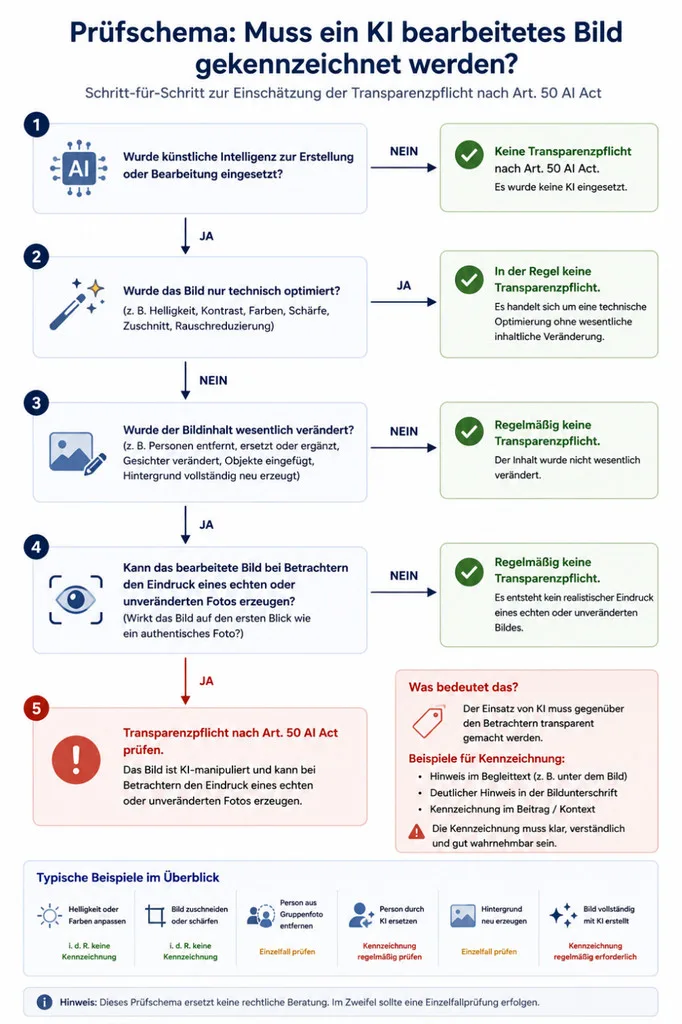
Note: This infographic was created with the support of artificial intelligence and subsequently reviewed and revised by our data protection and AI experts.
The graphic is intended as a first guide and does not replace a legal assessment of each individual case. Especially when it comes to marketing campaigns or publicity-oriented publications, a careful evaluation of the specific image manipulation is recommended.
What companies should now consider
From our consulting practice, it is particularly advisable to,
Since AI image processing functions are now integrated into many standard programs, appropriate changes are often made without sufficiently considering the legal implications.
Conclusion
The integration of AI image processing into common software facilitates numerous workflows for companies. At the same time, it creates new data protection and regulatory issues that are often underestimated.
In short: The GDPR answers the question of whether personal data may be processed. The AI Act answers the question of whether the use of artificial intelligence against third parties must be made transparent.
Our experience shows that these two examinations are often mixed together. Those who cleanly separate the two regulatory areas from each other and incorporate the relevant requirements early on into existing processes create more legal certainty and reduce the risk of later adjustments.
FAQ
Do AI-edited images always need to be labeled?
No. Not every processing using artificial intelligence automatically triggers a labeling requirement. In particular, the type and scope of the change as well as the specific purpose of use are crucial. 2026-07-20_AI changes images …
What is the difference between the GDPR and the AI Act regarding AI-processed images?
The GDPR specifically regulates whether personal data is processed, whether there is a legal basis for this, and what rights data subjects have. The AI Act, by contrast, aims to create transparency regarding the use of artificial intelligence. Therefore, both regulatory areas must be examined separately.
Which image modifications are not considered to be a significant change on a regular basis?
Pure technical optimizations such as adjustments to brightness, contrast, or colors, the removal of image noise, minor retouching, or cropping an image can regularly fall below the threshold of a significant change.
When can AI image processing be essential?
A significant change may occur in particular when people are removed or added, faces are exchanged, backgrounds are completely replaced, objects are inserted, or realistic image content is recreated. What matters is whether the meaning or perception of the image changes significantly.
Does a group photo have to be labeled if a person was removed using AI?
Not necessarily. Provided that only one person is removed and no misleading or deceptive impression is created, a transparency label under the article will not usually be required. Otherwise, this may be assessed if the editing significantly changes the content or overall impression of the photo.
What should companies take into account organizationally when using AI image processing?
Companies should evaluate data protection and the AI Act separately, document AI image processing, examine the further identification of individuals, and establish binding approval processes and clear responsibilities for any labeling requirements.